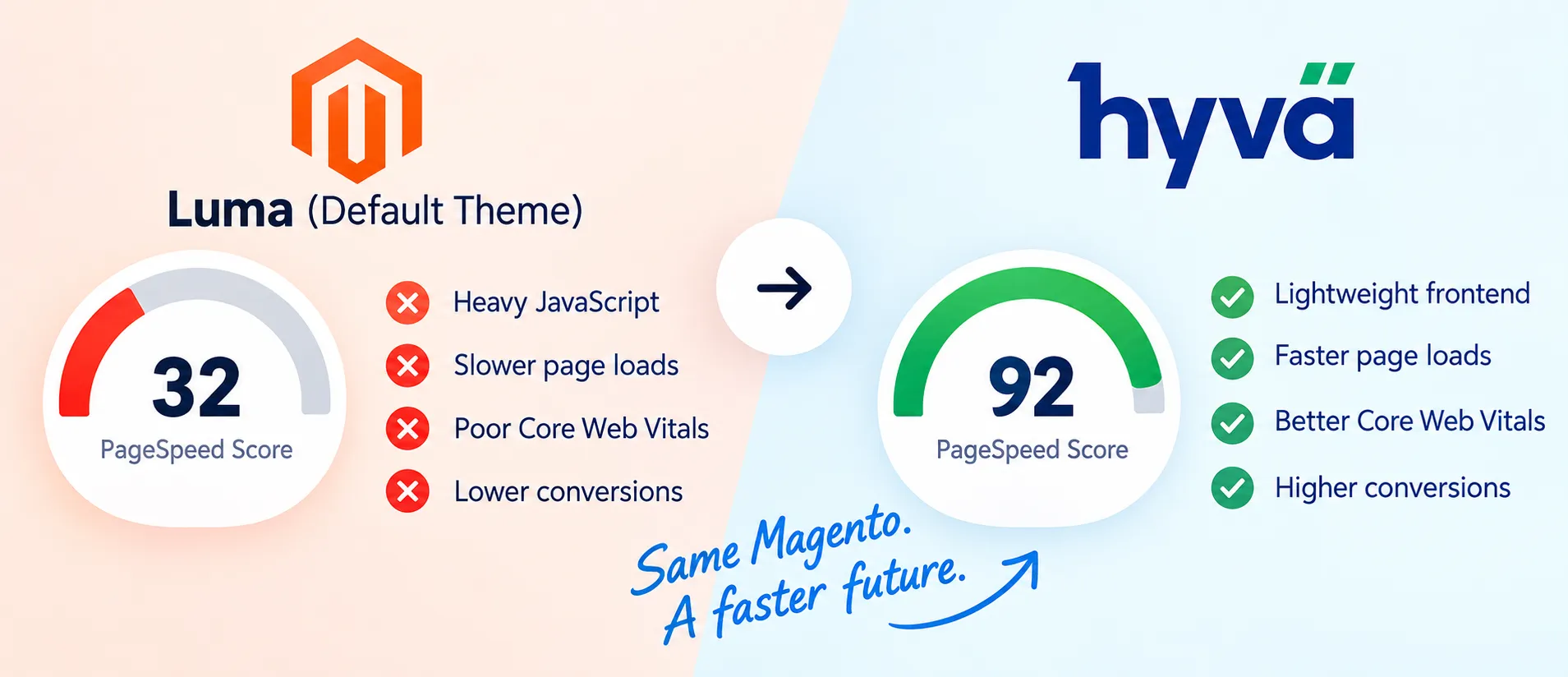
If your Magento store feels sluggish, takes too long to load product pages, or scores poorly on Google’s Core Web Vitals, there’s a good chance the problem isn’t Magento itself. It’s the theme running on top of it.
Most Magento stores still run on Luma, the default theme that’s shipped with the platform for years. Luma wasn’t built with modern performance standards in mind, and it shows. Hyvä has become the go-to fix for this, and for good reason. Here’s what’s actually going on, and what switching involves.
Why Luma makes Magento feel slow
Luma relies heavily on Knockout.js and RequireJS to render the frontend, which means a lot of JavaScript has to load and execute before a page is fully usable. Combine that with layers of XML processing and legacy code patterns, and you end up with pages that are technically working but slow to become interactive, even on decent hosting.
This isn’t a hosting problem you can fully fix by throwing more server resources at it. The theme architecture itself is the bottleneck. That’s why two stores on identical hosting, one on Luma and one on Hyvä, can have dramatically different load times.
What Hyvä actually changes
Hyvä strips out the Knockout.js and RequireJS layer entirely and rebuilds the frontend using Tailwind CSS and Alpine.js instead, both of which are lightweight, modern tools built for speed. The result is a frontend that renders faster, uses far less JavaScript, and gives developers a simpler codebase to work with going forward.
In practical terms, stores that migrate to Hyvä typically see:
- Significantly improved Largest Contentful Paint (LCP) and Interaction to Next Paint (INP) scores
- Better Core Web Vitals overall, which Google factors into search rankings
- Faster page loads across both desktop and mobile
- A simpler, more maintainable codebase for future development
Is Hyvä a full replatform?
No, and this is worth being clear about. A Hyvä migration isn’t the same as moving from Magento to Shopify or another platform. Your products, customer data, orders, and backend all stay exactly as they are. You’re replacing the frontend theme layer, not the platform underneath it.
That said, it’s not a simple flip of a switch either. Any custom Luma templates, checkout customisations, and third-party extension integrations need to be reviewed and often rebuilt for Hyvä compatibility. If your store has a lot of custom functionality built into the Luma theme over the years, that work needs proper scoping before migration starts.
How long does it take, and what does it cost
Timelines vary based on how customised your current theme is. A relatively standard store with limited custom functionality can be migrated in a matter of weeks. A store with significant custom Luma work, heavy extension use, and complex checkout logic can take considerably longer, since each piece needs to be audited and rebuilt rather than just switched over.
Cost follows the same logic. The more custom work built into your current theme, the more there is to carry across. This is why a proper audit before quoting matters. A generic estimate without looking at your actual store isn’t a reliable number to plan around.
If your Magento store is struggling with speed, Core Web Vitals, or general performance, and you don’t have a strong reason to move off Magento entirely, a Hyvä migration is usually the more sensible fix before considering a full platform change. You get the performance benefits without the risk, cost, and disruption of a complete replatform.
The exception is if your store has such heavy custom Luma functionality that the migration effort starts approaching the cost of a rebuild anyway. That’s a conversation worth having honestly with whoever’s scoping the work, rather than assuming Hyvä is automatically the cheaper option.
Is it worth it for your store
If your Magento store is struggling with speed, Core Web Vitals, or general performance, and you don’t have a strong reason to move off Magento entirely, a Hyvä migration is usually the more sensible fix before considering a full platform change. You get the performance benefits without the risk, cost, and disruption of a complete replatform.
The exception is if your store has such heavy custom Luma functionality that the migration effort starts approaching the cost of a rebuild anyway. That’s a conversation worth having honestly with whoever’s scoping the work, rather than assuming Hyvä is automatically the cheaper option.
Not sure if your Magento store is a good fit for Hyvä? Get a free technical assessment